


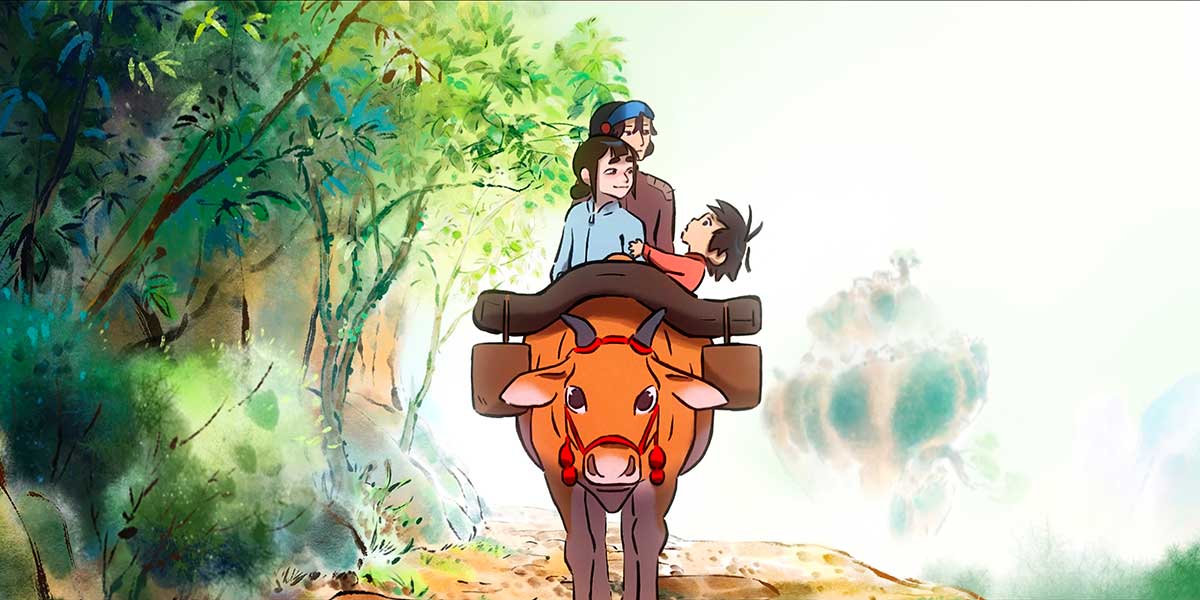
There are films that entertain us, and then there are films that quietly stay with us after the lights come back on. Muyi, la légende du village des femmes belongs to the latter.
I watched Julien Chheng’s animated feature yesterday at TIFF Bell Lightbox during the Toronto International Film Festival, and what stayed with me was its extraordinary visual warmth and its deeply hopeful message about women, courage and the freedom to shape one’s own destiny.
A French-language production set in a fantastical version of China, Muyi follows a teenage girl who lives with her grandmother in a remote mountaintop village inhabited exclusively by women. The community has its traditions and strict rules, and Muyi has grown up accepting them. But like many young people on the threshold of adulthood, she is curious about what lies beyond the world she knows.
Her curiosity takes flight when travelling theatre performers arrive in the village and stage a story about The Handsome General, a mysterious warrior whose striking appearance is so powerful that he must hide behind a mask. What initially seems like an enchanting performance soon becomes the beginning of something much bigger. Old secrets surface, familiar stories begin to look different, and Muyi finds herself drawn into an extraordinary adventure.
One of the film’s most striking qualities is its animation. The colours are vibrant, expressive and full of life. There is a sense of movement and magic in the visual world that makes the film particularly immersive on the big screen. The beauty of the animation isn’t simply decorative; it helps create the feeling of entering a world where mythology, imagination and reality can exist side by side.
But beneath the colourful imagery is a story about growing up and questioning what we inherit.
Muyi is raised within a community whose traditions have been passed down through generations. As she ventures beyond what she has always known, she begins to understand that the stories we inherit are not always the complete story. Sometimes, discovering the truth means looking at familiar legends from another perspective.
That idea gives the film an especially meaningful dimension.
At its heart, Muyi is also a story about women. The film places women at the centre of its world and explores their relationships with tradition, community and individual freedom. Muyi’s journey is not simply about finding adventure; it is about finding her voice and understanding that she can have a role in determining the direction of her own life.
I particularly appreciated that the film approaches empowerment through storytelling rather than turning it into a lecture. Muyi’s independence develops through curiosity, experience and discovery. She learns by venturing beyond the boundaries that have defined her, and in doing so begins to understand herself more clearly.
The fantastical characters add to the charm. A vegetarian tiger, a magical guide and the performers who arrive at the village give the story an almost fairytale quality. There is humour and wonder throughout, but the film doesn’t lose sight of its more mature themes.
For me, one of the most beautiful ideas in Muyi is that growing up isn’t necessarily about rejecting where you come from. It can mean understanding your past, questioning what you’ve been told, and then deciding what you want to carry forward.
That makes Muyi’s journey feel universal.
Although rooted in a distinctive cultural and mythological setting, the emotional questions at the centre of the film are ones many of us can recognize: Who am I? Where do I belong? What happens when the world I have been taught to believe in turns out to be more complicated than I imagined?
And perhaps most importantly: Can I write my own story?
Julien Chheng and co-screenwriter Sujuan Xu offer an enchanting answer.
Muyi, la légende du village des femmes is a visually gorgeous and inspiring animated film, but its greatest strength is the sense of possibility it leaves behind. It encourages young women—and, really, all of us—to be curious, to question, to discover and ultimately to find the courage to define our own path.
Leaving TIFF Bell Lightbox after the screening, I found myself thinking less about the fantastical creatures and more about Muyi herself: a young woman who discovers that the most important legend may be the one she chooses to create for herself.