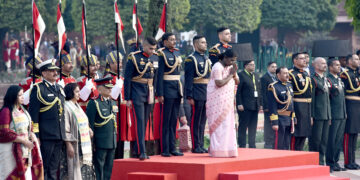


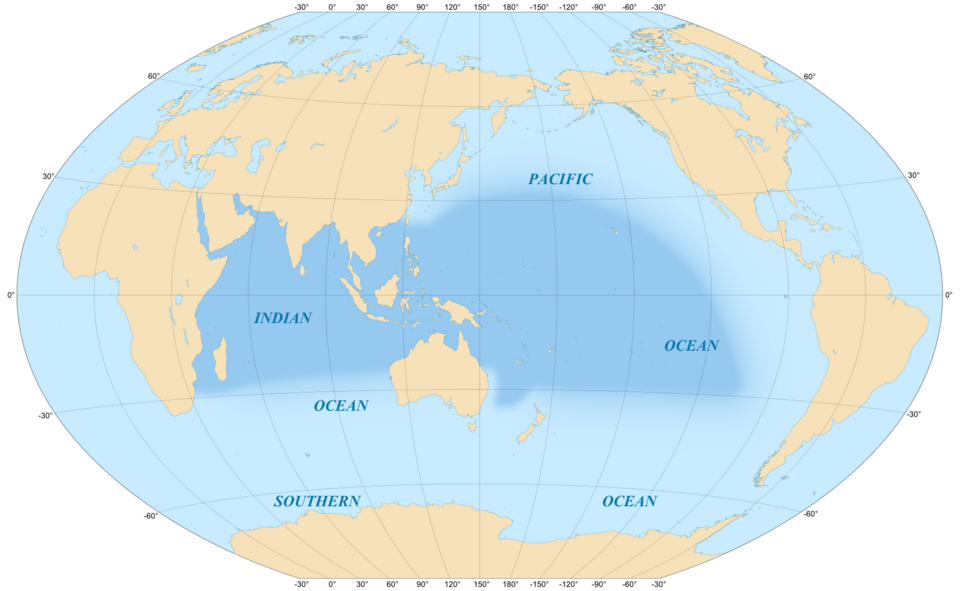
On 20 October 2025, on the occasion of Deepavali, the great Indian festival of lights, Prime Minister Narendra Modi, speaking from aboard India’s first indigenously built aircraft carrier INS Vikrant, drew attention to the centrality of the Indian Ocean in India’s strategic calculus. He recalled that 66% of the world’s oil supply and 50% of global container shipments pass through the Indian Ocean. “And in securing these routes”, he said “the Indian Navy stands guard like the sentinel of the Indian Ocean”.
The perception of the Indian and the Pacific Oceans as one strategic space gained traction in the mid-2000s, particularly in India after the Japanese PM Shinzo Abe in a speech to the Indian parliament in August 2007, referred to the Confluence of the Two Seas. In a decade, ‘Indo-Pacific’ became a globally accepted term after US President Trump in his address to APEC summit in Vietnam in 2017 called for a
free and open Indo-Pacific.
India’s Indo-Pacific vision was articulated by PM Modi at the Shangri La Dialogue in June 2018. He said that the Indo-Pacific region, inter alia, “stands for a free, open, inclusive region which embraces us in a common pursuit of progress and prosperity. It includes all nations in this geography as also others beyond who have a stake in it”.
In a sense, this was an organic evolution of India’s foreign and security policy, whose reorientation had begun in the 1970s and accelerated since the end of the Cold War in 1991. From a predominantly continental orientation, India began to focus on its maritime advantages, particularly its dominant position in the Indian Ocean. The Indian navy was in the forefront of this reorientation. From a coastal force, it became a balancing force in the 1970s and a blue water navy by the 1980s, dominating the northern and central Indian Ocean from the 1990s.
India’s economic liberalization also made it view countries to its east, particularly the Tiger economies and the Association of South East Asian Nations (ASEAN), as attractive partners for economic growth and shared prosperity. Thus, in 1992 India’s Look East Policy (LEP) was launched and institutional dialogue
commenced with ASEAN. In 2012 India and ASEAN became strategic partners; the relationship was elevated to a comprehensive strategic partnership in 2022. Over the years, India also established with other partners plurilateral groupings including BIMSTEC focusing on the Bay of Bengal region and the Mekong Ganga Cooperation (MGC) mechanism. In 2014, India elevated its LEP to Act East policy, significantly adding substance to its engagement.
India’s Indo-Pacific vision has many building blocks. In 2015, PM Modi launched its policy for the Indian Ocean Region (IOR) – Security and Growth for All in the Region (SAGAR). The SAGAR policy has five components: safety and security of the Indian mainland and island territories and ensuring a safe, secure and stable IOR; deepen economic and security cooperation with friends in the IOR through
capacity building; collective action and cooperation; work towards sustainable development of all; increased maritime engagement as the primary responsibility for the stability and prosperity of the region lay with those in the region. India is also a founder member of the Indian Ocean Rim Association (IORA), a 23-member body established in 1997 that promotes economic cooperation, maritime security and
sustainable development. India’s Act East policy is the umbrella policy that upholds ASEAN centrality and ASEAN’s various mechanisms including the East Asia summit as apex platforms for dialogue.
The 2004 Tsunami established India’s credentials in disaster relief operations as well as rehabilitation. From the eastern shores of Africa to the Pacific islands, India has extended humanitarian assistance in times of disaster and crisis. India’s speedy assistance to Myanmar in the aftermath of Cyclone Nargis in 2008; when neighbouring Maldives faced a freshwater crisis in 2014 India was the first country to
deliver drinking water under Operation Neer; in 2018, India stood shoulder to shoulder in relief and rescue efforts in Tsunami- struck Indonesia; in 2019, India was the first responder when two tropical cyclones devastated Mozambique; in early 2025 when a massive earthquake affected Myanmar India launched Operation Brahma, an extensive tri-service operation; in end 2025, it extended timely
assistance to cyclone-ravaged Sri Lanka. On 19 January, India extended 30 tonnes of HADR to Philippines that had recently been struck by a Super Typhoon.
Development partnership is an intrinsic part of our Indo-Pacific vision. The Indian model of development cooperation involves grants-in-aid, concessional lines of credit, capacity building and technical assistance. Significantly, it is unconditional, transparent, sustainable, financially viable and undertaken at the request of the partner state in keeping with the latter’s priorities. India’s vaccine outreach during the
Covid-19 pandemic to both developed and developing states is perhaps unprecedented. In 2023, during its presidency of G-20, India succeeded in amplifying the voice of the global south and championed development cooperation. In 2025, PM Modi announced MAHASAGAR, an updated version of the SAGAR doctrine, that marked an evolution from a regional focus to a global maritime vision with emphasis
on the global south.
As a preferred maritime security partner in the Indo-Pacific, India’s engagement has included joint exercises at the bilateral and plurilateral level, naval symposia, capacity building as well as exports of defence equipment either as a grant or under a defence line of credit at the request of the partner state. A crucial aspect of maritime security is enhanced maritime domain awareness. Thus, India has been pursuing white shipping agreements with several countries and has established a state-of-the-art Information Fusion Centre (IFC – IOR) that facilitates sharing of real time information with member countries.
Freedom of navigation and unimpeded commerce is one of the main aspects of our Indo-Pacific vision. In 2024, under Operation Sankalp, the Indian Navy deployed over ten warships including guided missile destroyers and frigates in the Gulf of Aden and the Arabian Sea to protect commercial shipping in the wake of Houthi-led attacks. This was the largest deployment by any country.
At a time of global churn and unpredictability, India continues to uphold its role as a responsible member of the international community that contributes to the stability, prosperity and a rules-based order in the Indo-Pacific region.
By Ambassador (Retd) Suchitra Durai
Former Ambassador of India to Thailand