


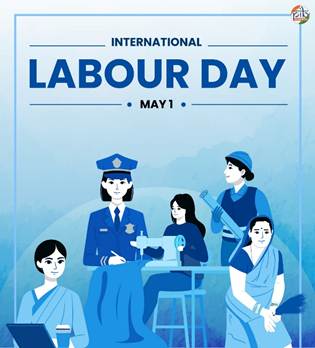
Not long ago, much of women’s work in India remained unseen. It was largely within households, family enterprises, and informal roles that rarely found mention in official records. Their contribution was constant, but recognition was limited.
That picture is now changing, reshaping the country’s labour landscape.
This International Labour Day, the story of India’s workforce is being defined by women who are not only entering the labour force in greater numbers but also redefining what participation looks like across sectors, systems, and emerging opportunities.
The shift is visible in the data. The Periodic Labour Force Survey shows that female labour force participation has risen sharply, from 23.3 per cent in 2017–18 to 40 per cent in 2025. Rural India continues to lead this change, pointing to a deeper structural shift in how women engage with work, not just as occasional contributors, but as consistent economic participants. This rise also reflects a broader expansion of employment opportunities and a steady movement towards formalisation in the labour market.
But numbers only tell part of the story.
Across villages and small towns, women are moving beyond traditional roles into entrepreneurship at an unprecedented scale. Under the Deendayal Antyodaya Yojana–National Rural Livelihoods Mission, more than 10 crore women households have been mobilised into self-help groups. What began as a pathway to financial inclusion has steadily evolved into a network of micro-enterprises, where women are producing, managing, and selling, often becoming primary earners within their households.
This momentum is further reinforced by a renewed policy push to strengthen women-led enterprises. Initiatives such as the Lakhpati Didi programme are focused on enabling women in self-help groups to scale their incomes sustainably, with the aim of creating crores of women entrepreneurs earning over ₹1 lakh annually. Combined with expanded access to credit, skills, and market linkages, this marks a transition from participation to income security, where women are not just working, but building more resilient livelihoods.
This transition from invisible labour to visible enterprise is quietly reshaping local economies.
This entrepreneurial shift is also reflected in India’s expanding startup ecosystem. Under the Startup India initiative, the country has emerged as the world’s third-largest startup hub, with over 2.2 lakh recognised startups generating more than 23.3 lakh jobs. Notably, over 1 lakh of these startups include at least one woman director, highlighting the growing presence of women in innovation-driven sectors. With improved access to funding, incubation support, and a more enabling policy environment, women are increasingly stepping into leadership roles, marking a shift from participation to entrepreneurship in India’s new economy.
At the same time, access to skills is opening new pathways. Under initiatives such as the Skill India Mission and other government-led skilling programmes, women are being equipped with industry-relevant skills across sectors. This growing emphasis on industry-relevant skilling is helping improve employability and support a transition towards more stable and productive livelihoods.
Yet participation is not only about access, it is also about security and dignity at work.
Recent labour reforms have sought to address this gap. The consolidation of 29 Central labour laws into four Labour Codes has simplified the regulatory framework while expanding the ambit of protection. Provisions related to minimum wages, occupational safety, and social security are now designed to cover a broader segment of the workforce, including those in informal and unorganised sectors.
As Prime Minister Narendra Modi noted while welcoming the implementation of these reforms, “These Codes will serve as a strong foundation for universal social security, minimum and timely payment of wages, safe workplaces and remunerative opportunities for the people, especially Nari Shakti and Yuva Shakti.”
For women, this marks an important shift, from limited access to a more structured framework that recognises their role in the workforce and seeks to ensure safe, equitable, and dignified working conditions.
This transformation is being reinforced through a continued push towards formalisation. The e-Shram portal, which has registered over 31 crore unorganised workers, is building a comprehensive national database to improve the delivery of welfare schemes. These registrations include women workers across sectors such as agriculture, construction, and other informal occupations that have traditionally remained outside formal systems.
At a broader level, India has expanded its social protection coverage from about 19 per cent in 2015 to over 64 per cent in 2025, reflecting a substantial widening of access to social security benefits, including provident fund, insurance, and healthcare. This expansion is especially relevant for women, who are more likely to be engaged in informal employment.
The impact of these efforts is also reflected in the strengthening of healthcare services under the Employees’ State Insurance (ESI) Scheme, a key pillar of India’s social security framework. A recently inaugurated ESIC hospital in Budgam, Jammu & Kashmir, will serve over 50,000 workers and their families, improving access to medical care and reinforcing the broader objective of worker welfare.
What is emerging is not a single story, but a broader pattern of change.
- Women are participating in the workforce in greater numbers.
- They are increasingly engaged in income-generating activities and local enterprises.
- They are gaining access to skills, social security, and formal systems.
- And they are becoming more visible within the economic framework.
At the same time, this growing economic participation is beginning to intersect with wider questions of representation and leadership. Legislative measures such as the Nari Shakti Vandan Adhiniyam reflect a broader emphasis on strengthening women’s role in decision-making.
International Labour Day, therefore, is not only a moment to reflect on the rights of workers, but also to recognise the ongoing transformation in the workforce. As participation expands and systems evolve, the focus is increasingly on ensuring that work is secure, dignified, and inclusive.
In this changing landscape, women are not just part of the workforce, they are playing a central role in shaping its future.