


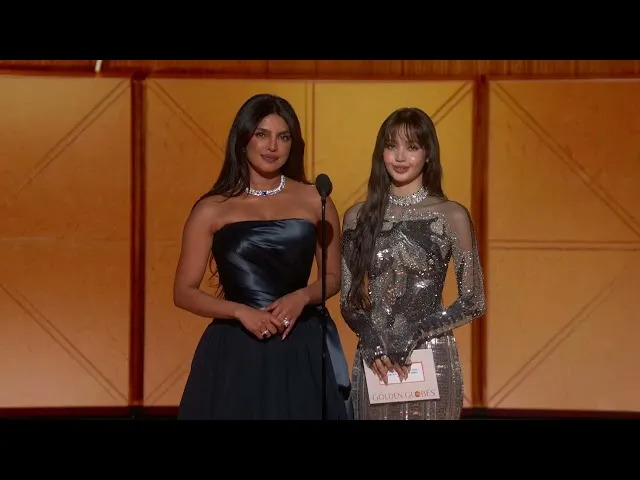
When Priyanka Chopra Jonas and Lalisa Manobal stepped onto the stage to present the Best Male Actor – Television – Drama award at the 83rd Annual Golden Globes, it was more than a routine awards-show pairing. It was a striking reflection of how global culture is no longer knocking at Hollywood’s door—it’s standing confidently at the center of the room.
Priyanka Chopra Jonas, a veteran of both Indian cinema and Hollywood, represents a generation of performers who have refused to be confined by geography. From winning Miss World to leading Bollywood blockbusters and carving out a sustained career in American television and film, Chopra Jonas has become a symbol of cross-cultural fluency in an industry still grappling with meaningful representation. Her presence at the Golden Globes is no longer novel—it’s earned, expected, and influential.
Sharing the stage with her was Lalisa Manobal, known globally as Lisa of BLACKPINK, whose journey reflects the seismic shift in how stardom is defined. Lisa’s rise through K-pop and her expansion into fashion, performance, and acting signal a new era in which global audiences shape Hollywood just as much as Hollywood shapes them. Her appearance at the Golden Globes underscores the undeniable impact of Asian pop culture on Western entertainment institutions that once overlooked it.
Together, Chopra Jonas and Manobal embodied a subtle but powerful message: the future of entertainment is multilingual, multicultural, and unapologetically international. Presenting an award that honors dramatic excellence in television—a medium experiencing its own renaissance—the duo symbolized how storytelling itself has evolved. Today’s most compelling narratives are no longer bound to one accent, one background, or one market.
The choice of presenters also highlighted how awards shows are slowly recalibrating relevance. As viewership habits shift and younger, global audiences demand authenticity and inclusion, moments like this matter. They aren’t just about glamour; they’re about signaling who belongs on the world’s biggest stages. This presentation felt aligned with the times. It wasn’t performative diversity—it was a reflection of where talent, influence, and audiences already are.
As the Golden Globes continue to redefine themselves, the image of Priyanka Chopra Jonas and Lalisa Manobal standing side by side serves as a reminder: Hollywood’s power no longer lies in exclusivity, but in its willingness to reflect the world watching it.