

India Stack – The Indian Approach and Experience
Introduction
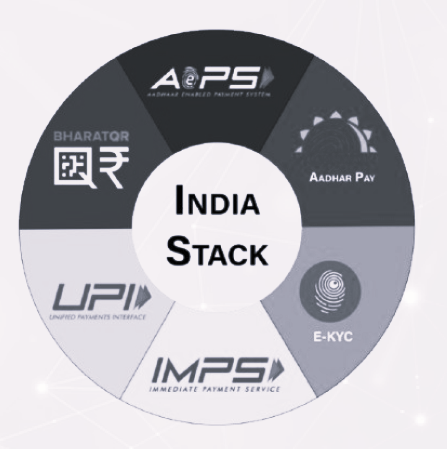
What is the India Stack? It is a collection of open Application Programming
Interface (APIs) and Digital Public Goods forming India’s foundational digital
infrastructure. Its components collectively enable various entities, including
governments, businesses and individuals to interact and conduct transactions
digitally. The India Stack components like Aadhaar (identity), UPI (payments),
DigiLocker (documents), e-Sign (digital signature), e-KYC (know your
customer), DBT (direct benefit transfer), Ayushman Bharat Digital Mission
(healthcare), etc, enable citizens, businesses and developers to avail of paper-
less, presence-less and cashless transactions and services.
The Indian Approach
The India Stack is a framework that aims to accelerate India’s digital
transformation and enhance financial inclusion.
Although the name of the project bears the word India, the vision of India Stack
is not limited to one country. It can be applied to any nation, developed or one
that is developing or emerging.
The project was conceptualized early this century, and first implemented in
2009 through the Aadhaar unique identity programme.
The India Stack is designed to provide a secure and interoperable platform for
the delivery of various services to citizens, leveraging the power of technology
and data.
How does the India Stack work?
The India Stack works through five layers.
The Cashless Layer, which supports an interoperable payment network, owned
and operated by the National Payments Corporation of India (NCPI). This layer
includes payments platforms like IMPS, which facilitates immediate electronic
transfers from one bank account to another, and UPI, an instant real-time
payment system from an individual or business/entity to another individual or to
a business/entity, thus replacing use of notes and coins. The UPI gained
immense popularity during the Covid period, and has been growing by leaps
and bounds in India, since then. These and other platforms like AEPS (Aadhaar
Enabled Payments System) and APB (Aadhaar Payment Bridge) reduce the cost
and risk of financial transactions.
The Paperless Layer enables storage and retrieval of information on real time
basis. Owned by the Department of Electronics & Information Technology, this
layer includes e-Sign, e-KYC and DigiLocker.
The Presence-less Layer provides unique digital biometric identities (Aadhaar)
with open APIs, enabling real-time, anytime, anywhere verification without
physical documents, thus reducing fraud and simplifying access to digital
services.
The Consent Layer empowers individuals with control over their personal data
through a framework for secure consented sharing featuring Electronic Data
Consent (EDC) for time/purpose limits; a Consent Artefact for transparency;
and regulated entities like Account Aggregators (AA) to manage data flow.
How does it work? To give an example, if an individual or entity seeks a loan,
he/it consents to share their financial data like bank statements, through an AA,
which securely retrieves the data from the bank with the consent given. The data
is shared with the loan provider, with the user’s specified permissions in the
Consent Artefact.
The Commerce Layer is driven by the Open Network for Digital Commerce
(ONDC), a Section 8 (not for profit) company. It features open protocols for
interoperability, standardized operations (inventory, cataloging), data privacy,
and a consent-based framework, enabling seamless integration between buyers
and sellers. It helps reduce monopoly, fostering a competitive digital
marketplace, lowering entry barriers for smaller sellers like MSMEs and the
neighbourhood kirana (grocery) store. This layer’s foundation is laid on India’s
Digital Public Infrastructure (DPI), using Aadhaar, UPI, DigiLocker and the
Consent Layer.
India’s Experience with the India Stack
Hundreds of millions of Indian citizens and residents have onboarded various
components the India Stack-built DPI, to avail of safe and secure financial,
healthcare, education and other services. Its key deliverables are:
– Delivers complete services to citizens
– Main focus is to improve people’s lives
– A product of several years of innovation
– A paper-less and cashless delivery system
It has facilitated the creation of innovative solutions and startups that leverage
digital technology to address societal challenges and improve access to services
for all segments of the population. India’s experience can be summed up in the
following outcomes.
Financial Inclusion: India Stack plays a crucial role in promoting financial
inclusion by providing a digital platform for banking, payments and financial
services. It has enabled people, who were earlier excluded from financial
systems – those unbanked or underbanked – to access digital payments methods.
Access to Services: With India Stack, citizens can access a wide range of
government services, financial services, healthcare services, education
resources, and more, through digital platforms, enhancing convenience and
accountability.
Entrepreneurship and Innovation: India Stack’s open APIs have spurred
innovation by allowing startups and businesses to build new services on top of
the existing infrastructure. This has led to growth of a vibrant tech ecosystem.
Reduced Corruption: By enabling DBT and digital subsidies, the financial
benefits from government to citizens now reach his/her bank account directly
through DBT, rather than through intermediaries, as in the past. India Stack is
thus assisting in reducing leakages and corruption in the distribution of
government benefits and subsidies.
India’s model is being replicated globally, with the India Stack serving as a
blueprint for inclusive growth and digital transformation in other developing
countries.
Though some challenges remain on data privacy, cybersecurity, digital
inclusiveness and regulatory oversight, the India Stack has served the people of
the country well. It is also assisting several friendly countries to build their own
digital public infrastructure (DPI) for inclusive growth and digital
transformation.
(Ambassador Debnath Shaw)